
How to Write a Therapist Bio That Actually Gets Clicks
Here is what happens on the other side of your profile. Someone finally decides to look for a therapist. They open the Find a Therapist search, set a few filters, and land on a page of results. They scroll. They skim. And within a few seconds, they click on one or two profiles and move on.
Your bio decides whether one of those clicks is yours. Therapy is personal. A prospective client is not choosing a service, they are choosing a person to open up to. Your bio is the first conversation you will ever have with them, and most therapists write it like a resume instead.
On TherapyCloud, your bio lives in three parts: your Profile Headline, your Personal Statement, and your Approach to Therapy. Each one does a different job. Here is how to make all three work for you.
Start With the Headline: Your 120 Characters on the Search Page
Your Profile Headline is the short summary that appears with your name on the search results page. It is typically 120 characters or less, and it is the single most valuable real estate in your entire profile, because clients see it before they ever click.
A strong headline answers two questions instantly: who do you help, and with what? Compare these:
“Experienced licensed therapist helping clients reach their goals.”
“Anxiety and trauma therapist helping adults quiet the inner critic. EMDR certified. Telehealth statewide.”
The first could describe anyone, so it describes no one. The second tells an anxious adult scrolling at midnight that this therapist is for them. Be specific about your people and your specialty, and skip generic phrases like “safe space” and “judgment-free” at this stage. Every headline says that. Yours needs to say something only you can say.
The Personal Statement: Say What You Do in the Words Clients Search
Your Personal Statement is where you establish credibility: your years in practice, your license and credentials, your therapeutic approaches, and your areas of focus. This section does double duty. It reassures the reader, and it fills your profile with the specific terms that match what clients are actually filtering and searching for.
That second job is where specificity pays off. Clients search for “perinatal mental health,” not “women’s issues.” They search for “EMDR,” “couples counseling after infidelity,” or “teen anxiety.” The more precise your language, the more relevant searches you appear in, and the more qualified the clicks you get.
A working formula: years in practice and credentials, then two or three named approaches (CBT, EMDR, ACT, IFS), then your specialties in plain, specific terms. For example:
“I am a licensed professional counselor with 12 years in practice. I work primarily with adults navigating anxiety, panic, and childhood trauma, using EMDR and cognitive behavioral therapy. I also support new and expecting mothers through perinatal mood and anxiety disorders.”
Four sentences, and it is packed with terms a real client would type into a search bar.
Approach to Therapy: Where You Stop Sounding Like Everyone Else
If the Headline earns the click and the Personal Statement earns trust, the Approach to Therapy section earns the phone call. This is where you describe in more detail what makes you and your way of working unique.
The mistake most therapists make here is writing about therapy in the abstract. Instead, help the reader picture a session with you. What does the first appointment feel like? Are you warm and conversational, or structured and goal-driven? Do you assign homework? Do you laugh with your clients?
Write it the way you would say it out loud to a new client sitting across from you. Plain language, first person, speaking to “you” rather than “clients.” Many of the people reading your profile are nervous first-timers, and a bio that sounds like a human being lowers the barrier to reaching out. Jargon raises it.
Three Quick Wins Before You Hit Save
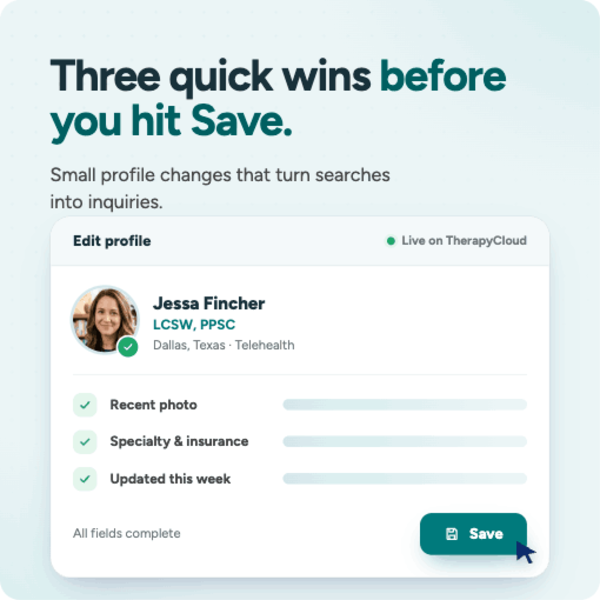
• Add a real, recent photo. Profiles with a clear, well-lit headshot of the therapist earn dramatically more clicks and inquiries than profiles without one. No photo creates doubt; clients often assume the therapist is inactive and keep scrolling. Skip the logo, the pet, and the beach sunset. A friendly photo of you, looking like you do today, is the visual handshake that makes your bio believable.
• Fill in every field, even the optional ones. Search results are built from filters like specialty, location, insurance, and telehealth availability. Blank fields quietly filter you out of searches you should be winning. Complete rates and insurance too, since clients use them to shortlist.
• Refresh it regularly. A small update every few weeks, like a tweaked headline or a newly added specialty, keeps your profile current for both the search engine and the client reading it.
Your Bio Is a Living Document
You do not have to get this perfect on the first pass. Write a draft, read it out loud, and ask one trusted colleague whether it sounds like you. Then revisit it as your practice evolves. The therapists who get the most traction treat their bio as something they tend, not something they finish.
Ready to put this to work? Log in to your TherapyCloud profile, and start with the 120 characters at the top. Your next client is already searching.