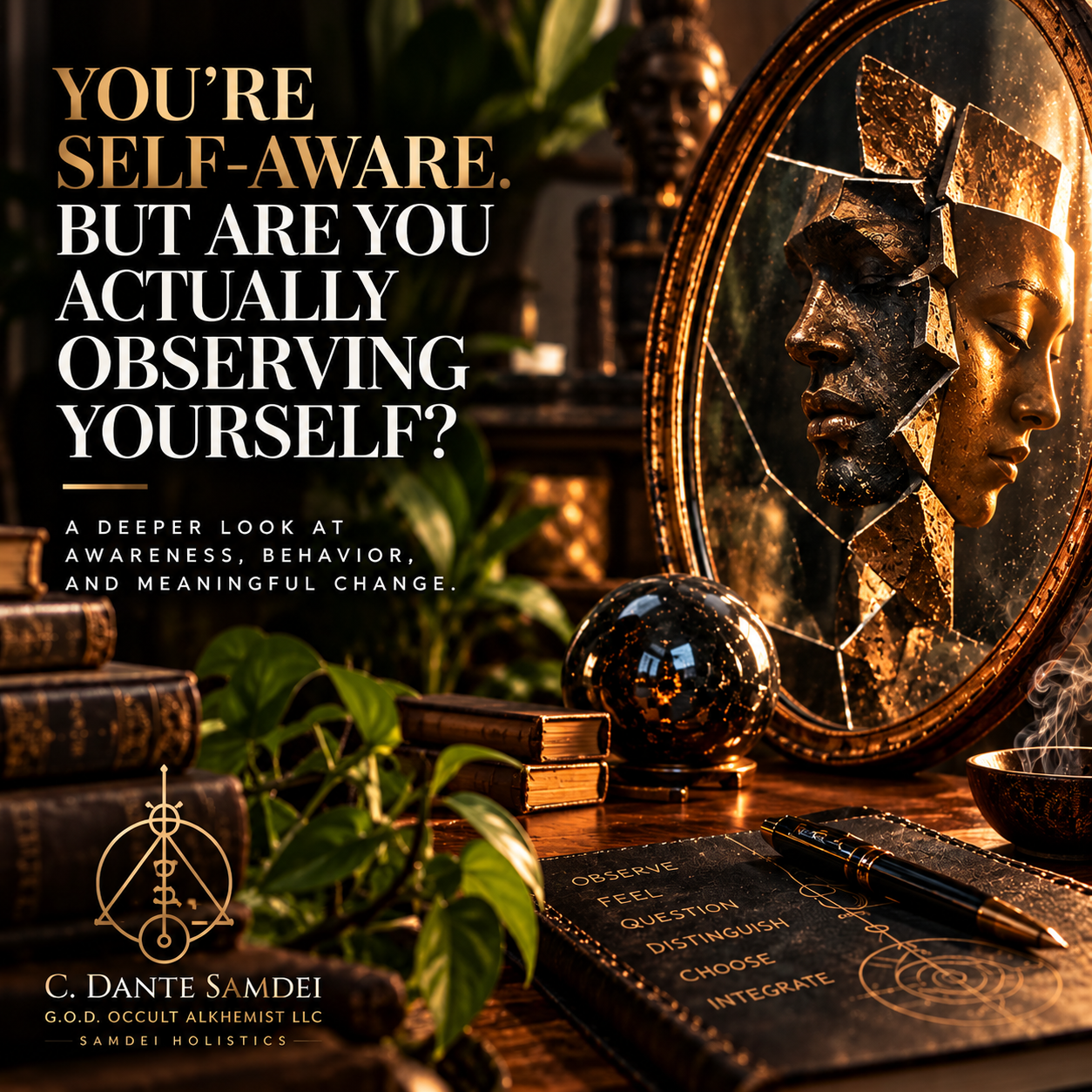
YOU’RE SELF-AWARE. BUT ARE YOU ACTUALLY OBSERVING YOURSELF?
SELF-AWARENESS CAN TELL YOU THE PATTERN EXISTS. OBSERVATION SHOWS YOU WHAT YOU DO WHEN IT ARRIVES.
There are people who can explain themselves exceptionally well.
They know their triggers. They understand their childhood. They can identify their attachment patterns, describe their coping mechanisms, recognize when they are dysregulated, and tell you exactly why certain relationships activate them.
They are not lacking information.
Yet the same pattern continues.
This does not necessarily mean the person is resistant to healing or unwilling to change. Sometimes it means something much simpler: awareness has been mistaken for interruption.
Recognizing a pattern and changing your participation in that pattern are two different skills.
Self-awareness allows you to say, “I do this.”
Observation eventually asks, “What exactly happens between the moment I become activated and the moment I do it?”
That space deserves considerably more attention.
AWARENESS IS IMPORTANT. IT JUST ISN’T THE FINISH LINE.
Self-awareness is necessary because we cannot consciously work with something we cannot recognize.
The problem begins when recognition itself starts feeling like transformation.
You identify that you overthink. You recognize that rejection activates you. You understand that uncertainty makes you anxious. You know that conflict makes you withdraw. You realize that you become controlling when you feel unsafe.
All of that matters.
But eventually another question has to enter the room:
What happens next?
Because your ability to accurately explain a pattern after it occurs does not necessarily mean you can recognize it while it is happening.
That is where observation becomes useful.
Observation slows the process down enough to examine its architecture.
WHAT ACTUALLY HAPPENED?
One of the simplest questions I use in therapeutic work is also one of the most difficult:
What actually happened?
Not what you believe it meant. Not what you are afraid it means. Not what happened the last time something similar occurred. Not what you believe the other person was secretly trying to do.
What happened?
Someone did not respond to your message.
That is an event.
“They are ignoring me” is an interpretation. “They do not respect me” is a conclusion. “I always get abandoned” may be an older story becoming attached to the current event. “I need to send another message right now” is an impulse.
These experiences can occur so quickly that they feel like one event.
They are not.
Learning to separate them creates options.
FEELING SOMETHING DOES NOT MAKE THE FEELING FALSE
Observation is not emotional invalidation.
If you feel rejected, the feeling is real. If you feel afraid, the fear is real. If you feel angry, the anger is real.
The presence of an emotion tells us something is happening within your experience. What it does not automatically tell us is why it is happening or whether your first interpretation is accurate.
Fear can indicate danger. Fear can also indicate uncertainty.
Anger can indicate a violated boundary. Anger can also emerge when reality refuses to cooperate with an expectation.
Rejection can be occurring. Or an unanswered message may simply be an unanswered message.
Emotions provide information.
They do not relieve us of the responsibility to investigate that information.
This distinction allows us to honor emotional experience without immediately surrendering decision-making authority to it.
THE BODY OFTEN ARRIVES BEFORE THE STORY
Patterns do not always begin as thoughts.
Sometimes your body notices first.
Your chest tightens. Your breathing changes. Your stomach drops. Your shoulders rise. Your jaw tightens. You become restless. Your attention narrows.
Then the mind begins constructing an explanation.
This is important because many people attempt to interrupt patterns only after the internal story has already gathered momentum.
By then, they are arguing with a conclusion.
Observation helps us move closer to the beginning.
What changed in my body?
What happened immediately before it changed?
What thought appeared next?
What am I preparing to do?
That sequence gives us data.
And data gives us somewhere to work.
INTERPRETATION IS NOT THE ENEMY
Human beings interpret.
We have to.
We use previous experience to understand current experience. We recognize patterns, anticipate consequences, evaluate risk, and make decisions based on incomplete information every day.
The goal is not to stop interpreting.
The goal is to recognize when interpretation has occurred.
Without that recognition, an assumption can quietly become a fact.
Once that happens, behavior begins responding to something that has not necessarily been established.
You confront someone for something you believe they intended. You withdraw because you have already decided what will happen. You seek reassurance because uncertainty has been interpreted as danger. You prepare for rejection before rejection has occurred. You attempt to control the outcome because not knowing feels intolerable.
The interpretation may eventually prove correct.
But observation gives reality an opportunity to provide evidence before the interpretation becomes instruction.
CURIOSITY CREATES ROOM
Curiosity is difficult when certainty has historically represented safety.
Certainty closes the question.
Curiosity keeps it open.
“I know why they did that” produces one type of behavior.
“I noticed what happened, and I do not yet know what it means” produces another.
That does not mean becoming naive, ignoring patterns, or repeatedly giving someone the benefit of the doubt when evidence has already established their behavior.
Discernment still matters.
The difference is that discernment uses information.
Fear frequently wants a verdict before all the information arrives.
Curiosity gives us enough room to discover which one is speaking.
OBSERVATION REQUIRES PRESENCE
This is where the work becomes uncomfortable.
Observation requires staying present long enough to witness yourself without immediately fixing, escaping, explaining, defending, or controlling what you discover.
Sometimes the urge itself is the information.
You notice how urgently you need an answer. You notice how quickly you want reassurance. You notice your impulse to leave. You notice that you are rehearsing an argument that has not happened.
You notice yourself collecting evidence for a conclusion you already made. You notice that you are more interested in proving your interpretation than discovering whether it is accurate.
Those observations are not indictments.
They are data points.
And once you can observe them without immediately obeying them, you have created something extremely valuable:
Choice.
SELF-AWARENESS WITHOUT PRACTICE CAN BECOME PERFORMANCE
There is a subtle trap in therapeutic language.
A person can become extremely skilled at describing themselves.
They can learn the vocabulary of boundaries, trauma, attachment, triggers, nervous-system regulation, accountability, shadow work, and emotional intelligence.
The vocabulary may be accurate.
But vocabulary can describe development without producing it.
Eventually, the language has to meet behavior.
Can you recognize the trigger before sending the message?
Can you notice the assumption before confronting the person?
Can you experience uncertainty without immediately purchasing certainty?
Can you identify the bodily activation before constructing a story around it?
Can you ask a question when your pattern wants to make a declaration?
Can you discover that your interpretation was wrong without experiencing correction as humiliation?
That is where awareness begins becoming capacity.
YOU NEED MORE THAN ONE DATA POINT
A single experience can matter without defining everything that follows it.
One disappointing interaction does not necessarily establish someone’s entire character. One moment of anxiety does not necessarily establish danger. One mistake does not establish incapability. One disagreement does not establish incompatibility.
At the same time, repeated data should not be ignored simply because we want a different conclusion.
Observation works in both directions.
It prevents us from constructing certainty too quickly, but it also prevents us from indefinitely explaining away what has become consistent.
The objective is not optimism.
It is accuracy.
Sometimes observation reveals that your fear was interpreting incomplete information.
Sometimes observation reveals that your instincts noticed a pattern before your conscious mind was prepared to acknowledge it.
Both are possible.
That is why we observe.
THE QUESTION CHANGES
Healing often begins with:
Why am I like this?
That question can open important doors.
Eventually, however, another question becomes more useful:
What am I doing right now?
That moves us from biography into participation.
Your history matters. Understanding how the pattern developed matters. Compassion for the version of you who needed that adaptation matters.
But the present version of you needs information about what is happening now.
What am I feeling?
What happened?
What did I interpret?
What evidence do I have?
What does my body appear to be preparing for?
What action am I considering?
What happens if I do not immediately act on the impulse?
That is observation.
Not detachment from yourself.
Contact with yourself.
FROM KNOWING YOURSELF TO WITNESSING YOURSELF
Self-awareness gives us language.
Observation gives us evidence.
Practice gives us range.
And range creates the possibility of responding differently.
The goal is not to become suspicious of every emotion or endlessly analyze every decision. The goal is to become familiar enough with your internal architecture that you can recognize when an old pattern has entered a new environment.
Sometimes the pattern will contain useful information.
Sometimes it will be responding to history.
Your responsibility is not to immediately know which one it is.
Your responsibility is to become capable of finding out.
Because eventually, healing requires more than being able to explain yourself after the fact.
It requires becoming present enough to witness yourself while you still have a choice about what happens next.
Awareness tells you the pattern exists. Observation shows you the pattern in motion. Integration changes your participation in it.
C. Dante Samdei
G.O.D. Occult Alkhemist LLC
Samdei Holistics