
Mental Health Misinformation Online: How to Vet What You See
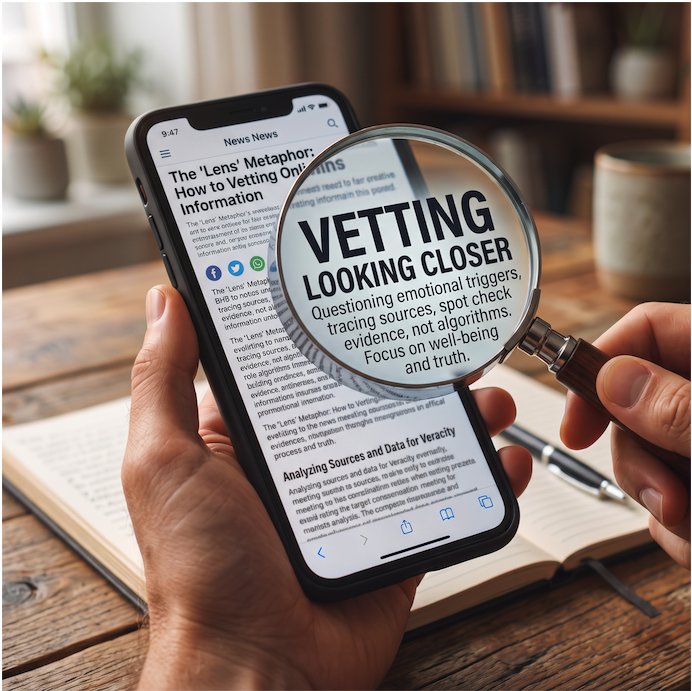
If your feed knows you have thought about therapy, it also knows exactly what to keep showing you. In 2026, mental health content is one of the most engaged categories on TikTok, Instagram, and YouTube Shorts. A short clip explaining ADHD, trauma, anxiety, or attachment styles can reach millions of people in a weekend. Some of that content is created by thoughtful clinicians and lived-experience educators. A lot of it is not.
A 2026 analysis of roughly 5,000 mental health posts across major social platforms found that up to 56 percent contained inaccurate or unsubstantiated information, with TikTok showing consistently higher misinformation rates than other platforms. A separate 2025 study of the top 100 videos tagged #ADHD found that 51 percent of them were misleading. And a recent Kaiser Family Foundation tracking poll found that roughly 31 percent of U.S. adults now turn to social media at least monthly for health information, and adults who use social media weekly are meaningfully more likely to believe false health claims than less frequent users.
This is not a story about scolding people for watching short-form video. Many of these creators are speaking from real experience, and some content is genuinely helpful. The problem is not that people are looking online. The problem is that the platforms reward emotional resonance over clinical accuracy, and the algorithm cannot tell the difference between a good therapist and a confident stranger.
Here is what to know, and how to check yourself before adopting a framework you saw at 11 p.m. on a Tuesday.
Why This Content Is So Convincing
Short-form video is engineered to feel personal. A creator looks straight into the camera, describes an internal experience with vivid specificity, and lists five signs you might have it. If any of those signs sound like you, your brain lights up. That is not weakness. That is how pattern recognition works. The problem is that many mental health conditions share overlapping signs, and almost any list of symptoms will feel like it describes you if it is written well enough.
There is also a personalization layer that makes the effect stronger than casual viewers realize. Once the algorithm identifies that you engage with mental health content, it starts serving you more of it, and it tends to escalate toward the framings that get the strongest emotional response. Videos that provoke a jolt of recognition (or of anger, or of validation) travel farther than videos that qualify their claims. Over the course of a few weeks of viewing, the frameworks in your feed can quietly narrow, and the internet begins to look like it agrees with itself.
Add in the fact that user-generated content about personal mental health experiences gets meaningfully more engagement than videos posted by trained clinicians, and you have an ecosystem where the loudest voices are often not the most qualified. The information is not always wrong. It is often incomplete, oversimplified, or presented with a confidence real experts almost never use.
The Conditions Most Commonly Misrepresented
Not all mental health content is equally shaky. Research consistently finds that some conditions attract higher rates of misinformation than others.
ADHD leads the list. Roughly half of top-ranked ADHD videos across recent studies have been rated as misleading or inaccurate, often because they present universal human experiences (procrastination, distraction, restlessness) as diagnostic symptoms.
Autism is a close second, particularly around adult self-identification content. Many videos accurately describe experiences of neurodivergent adults, but oversimplify how autism is diagnosed and often blur the line between autistic traits and other conditions.
Trauma and PTSD content is especially prone to the "everything is trauma" flattening. Real trauma responses are not the same as ordinary emotional discomfort, and treating them as identical can pull people away from care they might genuinely need.
Personality disorders (narcissism, borderline personality, avoidant attachment) generate a large volume of relationship-focused content that often diagnoses other people (parents, partners, exes) rather than helping viewers understand themselves. This category is worth extra skepticism.
Anxiety and depression content tends to be more accurate on average but is often paired with unproven treatment claims (supplements, nervous-system "reset" routines, breathwork protocols) that promise more than the underlying research supports.
Knowing which topics tend to run hot helps you slow down when the algorithm starts feeding you a lot of it.
A Simple Guide to Vetting What You See
You do not need a clinical degree to be a smarter consumer of mental health content. A few questions, asked before you accept a video's framework, can save you weeks or months of self-diagnosis anxiety.
1. Who is speaking, and what is their training? Look for actual credentials, not just relatability. Credentials like LMFT, LCSW, PhD in clinical psychology, and psychiatrist are meaningfully different from "mental health advocate" or "certified life coach." Both can be valuable, but the framing should tell you what kind of authority you are being offered.
2. How confident is the video? Genuine clinicians tend to hedge. They say things like "for some people," "one possibility," or "this varies." Content that says "if you do X, you have Y" is almost always oversimplifying. Certainty is a marketing tool, not a clinical one.
3. Is this a symptom list, or is it universal human experience? Ask honestly: could most people relate to at least half of these signs? If yes, the video is describing being human, not a specific condition.
4. What is missing? Reliable content usually names complexity. It talks about differential diagnosis, comorbidity, alternative explanations, or the role of context. If a video presents a mental health topic with no nuance and no alternative framings, treat it as a starting point, not a conclusion.
5. Is the creator selling something? Coaching programs, courses, supplements, and paid communities are common downstream products of mental health content. A creator can be trustworthy and also monetized, but knowing there is a financial upside to the framework you are adopting is important context.
6. Is the video diagnosing you or diagnosing someone else? Content that walks you through your own experience is different from content that identifies pathology in a parent, partner, or ex. The second category is much more likely to be misleading. Even when the observations are accurate, the format encourages splitting rather than curiosity.
7. Would you take medical information about your heart from this account? If not, hold mental health information to the same bar. Mental health is health.
What to Do If You Recognize Yourself in Something You Saw
Recognition is real information. If a video described something and you thought, "that is me," that reaction deserves attention. It also deserves a better next step than further searching your symptoms for four more hours.
The most useful move is to bring what you noticed to a licensed clinician who can help you sort out what fits, what does not, and what a responsible assessment might look like. In many cases, self-suspected diagnoses are worth taking seriously and formally evaluating. In many other cases, the framework was close but not quite right, and a good therapist can help you find language that fits your experience more precisely.
If therapy is not immediately accessible, other reasonable next steps include reading a full-length article or book on the condition (long-form content is much harder to fake or oversimplify), talking to someone who knows you well and asking what they have observed over time, and writing down the specific patterns you notice about yourself so a clinician can review real examples rather than a general impression.
How to Talk to Someone Who Is Getting Their Mental Health Information Online
If someone in your life is quoting TikTok back at you or self-diagnosing based on Instagram, the least useful response is contempt for the source. Most people who are pulling frameworks from social media are doing it because they are trying to understand something real that they have not had language for before. Meet the noticing with respect, and then, if the framework seems off, offer a slightly wider view. Something like, "I can see why that landed. I wonder if there is more to it," keeps the conversation open and models the kind of thinking you would want from a good clinician.
Frequently Asked Questions
Is all mental health content on TikTok inaccurate? No. Some clinicians and lived-experience educators produce excellent content within the short-form video format. The issue is not the platform itself. It is the mix of accurate and inaccurate content that shows up in the same feed, and the fact that the algorithm cannot differentiate between them.
Should I stop watching mental health content online? Not necessarily. For many people, this content is a first step toward taking their mental health seriously. The goal is not avoidance. It is a more careful relationship with what you see, so it complements professional care rather than replaces it.
Can I get a real diagnosis from a video? No. Diagnosis requires a trained clinician, a clinical interview, and often standardized assessments. A video can prompt you to seek evaluation, but it cannot provide one.
What if I saw a video that made me anxious about myself? That is common. Try to separate the recognition from the anxiety. Write down what specifically resonated, and bring that list to a therapist rather than trying to resolve it alone with more scrolling.
A Closing Reframe
The internet did not invent self-understanding, and it is not going to end it. But your feed is not a substitute for care, and the algorithm is not a diagnostic tool. Curiosity about your own mental health is a strength. What you do with that curiosity is what matters.
TherapyCloud connects you with verified, qualified therapists who can help you make sense of what you have been reading, watching, and wondering. If a video sparked something for you, that spark deserves a thoughtful next step. You do not have to figure it out alone.