Cozymaxxing, Floor Time, and TherapyTok: What TikTok Gets Right About Mental Health, and What It Doesn't
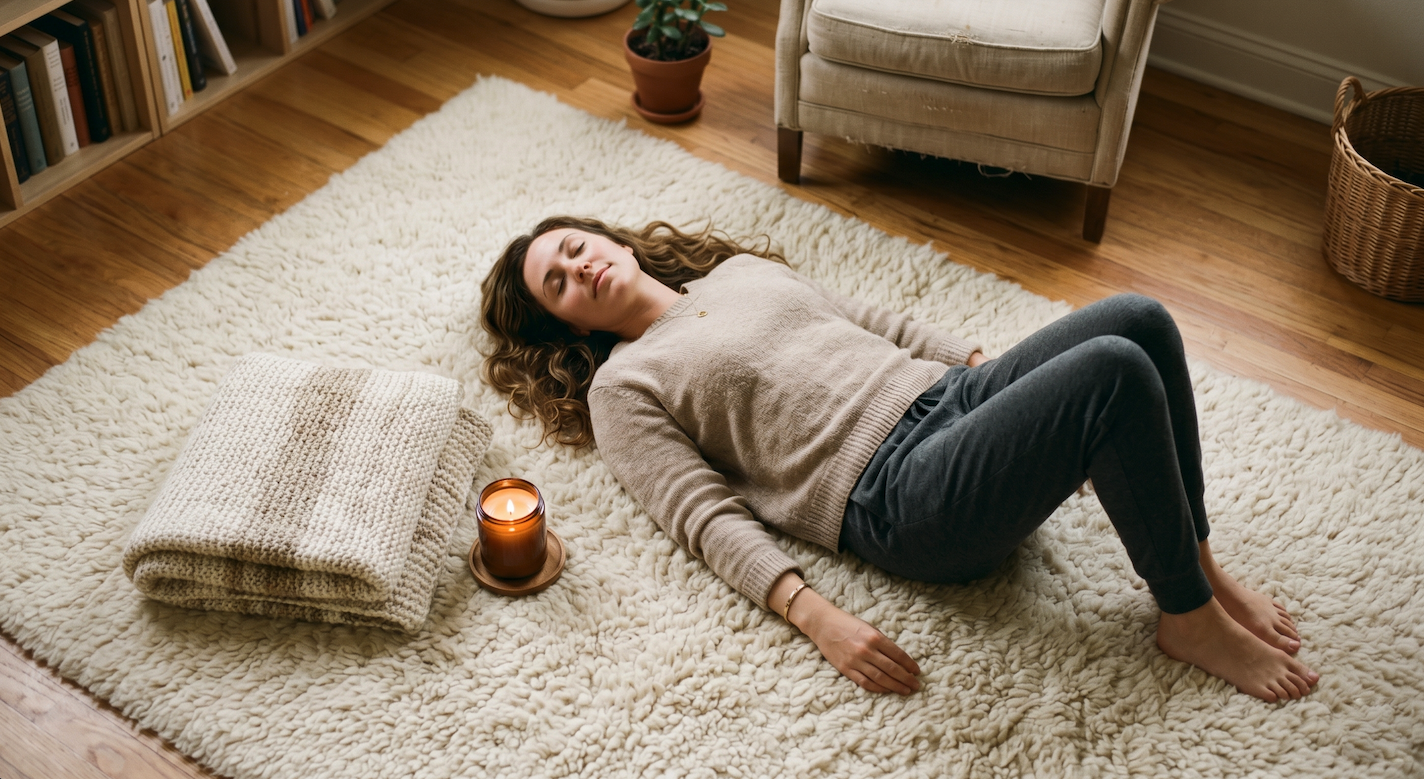
If you have spent any time on the mental health side of TikTok lately, you have probably seen the same two scenes on repeat. Someone in flannel pajamas lighting a candle and arranging an artful pile of blankets. Someone else lying flat on a hardwood floor or a patch of grass, eyes closed, captioning the video with something like the only thing that worked today.
The trends have names now. The first is called cozymaxxing. The second is called floor time. And both of them, despite the very online packaging, are pointing at something real.
The third TikTok trend worth talking about is less photogenic and more important. A peer-reviewed study found that 52 percent of the most popular ADHD-related videos on TikTok were classified as misleading. That number is the more important one, and it is the one we will get to.
Cozymaxxing: The Real Science Under the Soft Lighting
Cozymaxxing is the deliberate, ritualized version of climbing into pajamas, lighting a candle, and burrowing under a weighted blanket. The aesthetic is the part TikTok cares about. The mechanism is what therapists care about.
When you wrap yourself in deep pressure, in this case a weighted or layered blanket, you stimulate what researchers call the deep pressure touch response. This shifts the autonomic nervous system out of sympathetic activation (the fight-or-flight state) and into parasympathetic activation (the rest-and-digest state). Studies measuring this directly have found that parasympathetic activity increases under a weighted blanket, with corresponding decreases in cortisol, slower heart rate, and slower breathing. A 2024 review in the American Journal of Occupational Therapy found positive effects on mood and anxiety in adults using weighted blankets.
So yes, your nervous system actually does relax when you cozymaxx. The candle is for vibes. The blanket is doing real work.
The honest caveat is that cozy self-care can look identical to avoidance from the outside, and sometimes from the inside, too. Deep pressure and a quiet room are powerful regulation tools. They are not a substitute for addressing the source of the stress when there is one to address. A useful question to sit with: am I doing this to come back to my life or to keep avoiding it? The answer is not always the same one, and that is okay.
Floor Time: Why Lying on a Hardwood Floor Actually Helps
Floor time is exactly what it sounds like. People lie down on the carpet, the hardwood, the kitchen tile, sometimes a patch of grass in the backyard, and stay there for a few minutes. Then they get up and report feeling better.
This one also has real research behind it, although the research uses less photogenic language. Full body contact with a stable, supportive surface delivers strong proprioceptive input, which is a fancy term for where the body senses itself in space. That input is one of the fastest ways to signal safety to the nervous system. Grounding practices, including lying flat with attention on the body's points of contact with the ground, have been associated with increased heart rate variability, better vagal tone, and lower cortisol in published studies on stress physiology.
In other words, you are not being dramatic when the floor helps. You are doing a low-tech version of a regulation practice that somatic therapists have been recommending for years.
The simplest version: lie flat, eyes closed, breathe slowly, notice where your body meets the floor, stay there for five minutes. No app required.
The 52 Percent Problem
This is the part to take seriously.
In a peer-reviewed cross-sectional study published in the Canadian Journal of Psychiatry, researchers analyzed the 100 most popular TikTok videos tagged with ADHD. They classified 52 percent of them as misleading. Most of the misleading videos came from non-clinicians. The most common pattern was misattributing ordinary or transdiagnostic experiences (anger, mood swings, anxiety, relationship difficulty, dissociation) as ADHD-specific symptoms when they are not.
A 2025 follow-up study in JMIR Infodemiology found that fewer than half of symptom claims about ADHD on TikTok aligned with the Diagnostic and Statistical Manual of Mental Disorders (DSM), which is the official diagnostic book for mental health disorders. The newer research also found that frequent viewers of TikTok ADHD content tended to overestimate how common ADHD is in the general population.
This is not a reason to be cynical about every creator on TherapyTok. Many of them are doing thoughtful work and, for many viewers, TikTok has been the first place anyone has ever described their experience back to them in an accurate way. The point is to be a careful consumer, not a dismissive one.
A few questions worth holding up to any mental health content you scroll past.
Who is making this video? Are they a licensed clinician, a person sharing personal experience, or someone monetizing a brand?
Are they describing a clinical condition, or describing the experience of having one?
Is the symptom they are describing actually specific to the diagnosis they are naming, or is it something most humans feel sometimes?
Does the post invite you toward an assessment with a qualified professional, or does it imply you can self-diagnose from the video alone?
Personal-experience content from people sharing their own lives has real value. Misleading content packaged as clinical fact does not, and the second is harder to spot than the first.
Where TherapyCloud Fits
The honest truth is that a thirty-second video is a fine on-ramp. It is not a destination. If something you saw on TikTok genuinely landed, the next step is to talk to a person who can listen back.
TherapyCloud connects you with verified, qualified therapists. Cozy blanket optional. Floor optional. The right person to talk to, not optional.
Sources: Yeung, A., Ng, E., Abi-Jaoude, E., TikTok and Attention-Deficit/Hyperactivity Disorder: A Cross-Sectional Study of Social Media Content Quality, Canadian Journal of Psychiatry; Quality and Perception of Attention-Deficit/Hyperactivity Disorder Content on TikTok: Cross-Sectional Study, JMIR Infodemiology 2025; A double-edged hashtag: Evaluation of #ADHD-related TikTok content and its associations with perceptions of ADHD, PLOS ONE; Eron, K. et al., The effect of weighted blankets on sleep and related disorders: a brief review; Ekholm, B. et al., A randomized controlled study of weighted chain blankets for insomnia in psychiatric disorders; Sleep Foundation, Weighted Blanket Benefits. Note: nothing in this post is a substitute for assessment or care from a qualified clinician. If something you read or watched online resonated, that is information worth bringing to a professional, not a diagnosis on its own.