
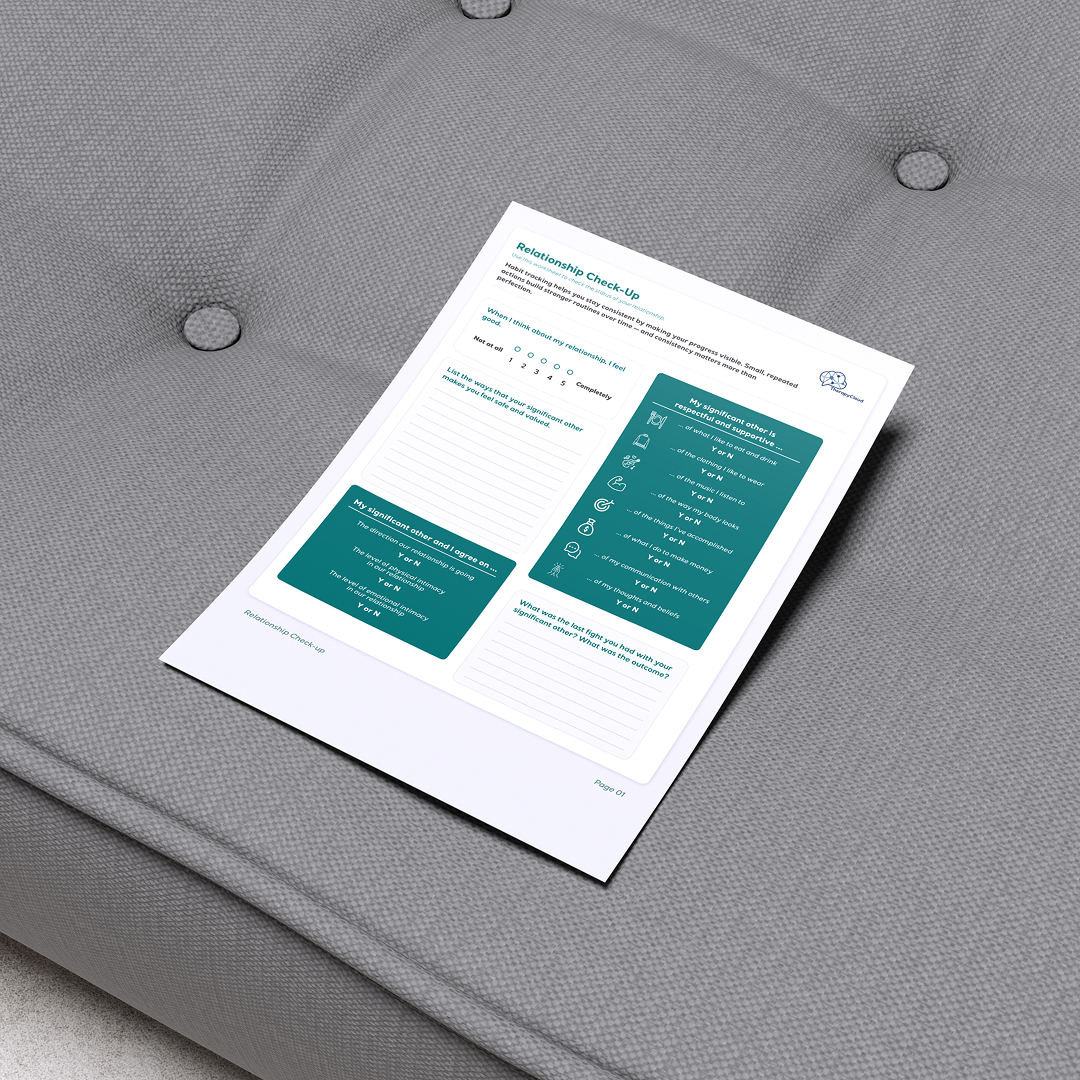
Relationship Check-Up: A Guided Assessment for Couples Work and Individual Therapy
A structured self-assessment to help clients evaluate relationship satisfaction, alignment, and areas of concern across respect, autonomy, agreement, and conflict. Useful in couples therapy, individual work addressing relationship patterns, or as a between-session reflection tool.
Details
The Relationship Check-Up guides clients through a structured evaluation of their current relationship -- covering how respected and supported they feel, where they and their partner are aligned, and how conflict is being handled. It creates a snapshot of relationship health that can open conversations clients might struggle to start on their own.
This worksheet is useful in couples therapy as a session primer, in individual therapy when relationship patterns are a focus, and in assessments where a therapist needs a quick read on relationship dynamics. It works across modalities including EFT, Gottman-informed approaches, CBT for relationship issues, and trauma-informed work where autonomy and safety in relationships are clinical concerns.
What makes this tool effective:
The worksheet is structured around three distinct but connected lenses: how the client feels overall, whether their partner demonstrates respect across specific domains of their life, and whether both partners are aligned on key relationship dimensions. That structure matters. A client who scores their relationship a 4 out of 5 overall might still reveal through the checklist that their partner is not supportive of their career, their body, or their beliefs -- details that get lost in a general satisfaction rating.The specificity of the respect checklist -- food, clothing, body, money, communication, thoughts and beliefs -- surfaces autonomy and control issues that clients often minimize or haven't consciously named. When a client marks "N" next to "of the way my body looks" or "of what I do to make money," that single data point can open a significant clinical thread.
The conflict question -- "What was the last fight you had, and what was the outcome?" -- adds behavioral data to the perception data. How a couple fights and whether conflict leads to resolution, escalation, or shutdown tells you a great deal about relationship patterns that satisfaction scores alone won't capture.
How to use this worksheet:
In couples work, have each partner complete the worksheet independently before reviewing together. Differences in perception between partners are often as clinically significant as the answers themselves. In individual therapy, use it when a client is processing relationship concerns, evaluating whether to stay or leave, or developing clarity about what they need from a partner. The worksheet can also be used periodically over the course of treatment to track whether relationship dynamics are shifting.For clients who are in relationships with controlling or unsafe dynamics, treat the checklist responses with particular attention. A pattern of "N" responses across the respect and autonomy items warrants direct clinical inquiry into safety and coercive control, not just conflict resolution skill-building.
What's included:
- Overall relationship satisfaction rating scale
- Open-ended prompt to identify what makes the client feel safe and valued
- Eight-item respect and autonomy checklist covering key life domains
- Three-item alignment checklist on relationship direction and intimacy
- Open-ended conflict reflection prompt
Frequently Asked Questions
Is this appropriate for clients who may be in an unhealthy or unsafe relationship?
It can be used thoughtfully, but review responses carefully before processing them in session. The respect checklist in particular can surface coercive control patterns. If a client marks "N" across multiple autonomy-related items, follow clinical protocol for safety assessment rather than treating this as a standard couples communication exercise.
Can this be used with individual clients, not just couples?
Yes, and it's often more useful in individual therapy than it might initially appear. Clients processing whether to end a relationship, working through patterns of choosing unavailable or controlling partners, or recovering from a past relationship can all benefit from completing this reflectively. It helps externalize and organize what can otherwise feel like a confusing tangle of feelings.
What if a client has a very low overall satisfaction score but positive checklist responses?
That discrepancy is worth exploring directly. Satisfaction is subjective and shaped by expectations, history, and attachment patterns -- not just by what's objectively happening. A client who feels bad in a relationship that looks functional on paper may be dealing with unmet emotional needs, unspoken resentments, or a mismatch between the relationship they have and the one they want.